What Anti-Slip FRP Plates Actually Are
FRP (fibre-reinforced polymer) plates are composite panels built from a polymer resin matrix reinforced with glass fibres. The construction gives them the structural rigidity needed for walking surfaces without the weight or corrosion problems of steel.
The "anti-slip" version takes that base material and adds a layer of hard mineral grit — typically aluminium oxide or quartz — directly into the resin during manufacturing. Because the grit is embedded into the plate itself rather than coated on top, the slip-resistant surface cannot peel, flake, or wear off the way painted finishes do. The traction is part of the plate, not a sacrificial layer.
Where They Get Used Offshore
FRP plates are versatile enough to cover almost every horizontal surface a worker might walk on across an offshore asset:
- Escape routes and walkways — high-visibility, slip-resistant paths along main thoroughfares and emergency egress corridors.
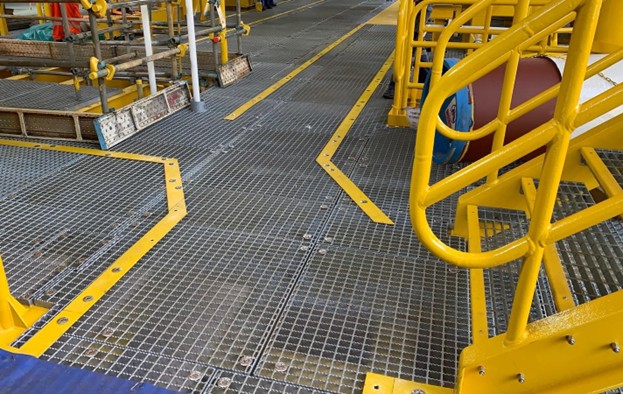
- Stair treads and ladder rungs — retrofitted over slippery steel steps to reduce falls during vertical transit, particularly in wet weather.
- Bridge decks — fitted over open steel grating to provide a solid surface that prevents tools or small debris from dropping to lower levels.
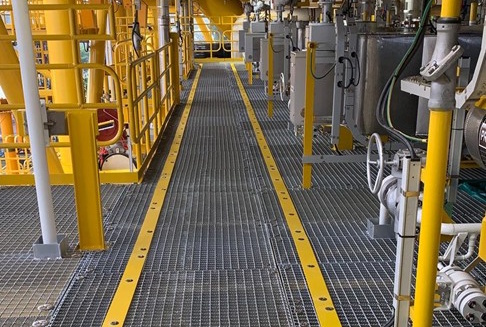
- Helideck perimeter walkways and platform edges — high-traffic areas where consistent slip resistance matters most.
Why Offshore Operators Choose FRP
1. Saltwater Doesn't Touch It
Offshore steel lives under constant salt spray and high humidity. Oxidation begins almost immediately, and once started, it propagates under coatings even where the surface looks intact. FRP is chemically inert to saltwater — it doesn't rust, rot, or scale. With minimal upkeep, a properly specified plate can hold its structural integrity for 20–25 years in service.
2. Strength Without the Weight
On an offshore platform, every kilogram counts toward fixed structural limits. FRP plates are typically around 70% lighter than steel equivalents while delivering comparable load-bearing strength. That weight saving can free up margin for additional equipment, simpler structural retrofits, or reduced lift requirements during installation.
3. Non-Conductive and Non-Sparking
FRP is an electrical insulator. In dense electrical environments — and especially in zones where flammable gases may be present — non-conductive and non-sparking surfaces meaningfully reduce the risk of accidental ignition or shock. This is one reason FRP often appears on production decks, near wellheads, and around switchgear rooms.
4. It Absorbs Impact Instead of Deforming
Drop a heavy tool on a steel plate and you get a permanent dent that becomes a trip hazard or a corrosion initiation point. FRP has enough elasticity to absorb the impact and return to shape, protecting both the plate and the structure beneath.
FRP Plates vs. Painted Steel Gratings
For decades the offshore standard was steel grating treated with anti-slip paint or cold-galvanised coatings. The performance gap with modern FRP is significant, particularly over the asset's full service life:
| Property | Painted Steel Grating | Anti-Slip FRP Plate |
|---|---|---|
| Surface durability | Paint chips and wears under traffic; steel underneath is then exposed to corrosion. | Grit is locked into the resin; the wear surface lasts the life of the plate. |
| Maintenance cycle | Periodic descaling, priming, and repainting. | Routine wash-down only; minimal long-term intervention. |
| Slip resistance over time | Falls as paint wears smooth — can become genuinely glassy. | Coefficient of friction stays consistent throughout service life. |
| Installation | Heavy panels; often requires welding or hot-work permits. | Lightweight; can be cut on-site and fixed with simple clip systems. |
| Chemical exposure | Paint can soften or dissolve under fuels, oils, or hydraulic fluids. | Inherently resistant to a broad range of industrial chemicals. |
What to Specify
When ordering anti-slip FRP for an offshore project, the variables that matter most are:
- Plate thickness — driven by span, point load, and the structure being covered.
- Grit size and density — coarser grit gives more aggressive traction but is harder underfoot; finer grit is preferable for high-traffic walkways.
- Resin system — isophthalic and vinyl ester resins offer different chemical resistance profiles; the right choice depends on what the plate will actually be exposed to.
- Colour and marking — high-contrast colours improve route legibility, and many specifications now require photoluminescent edges or arrows on escape paths.
- Fire performance — offshore applications typically require plates that meet relevant flame-spread and smoke-toxicity ratings.
Once those parameters are fixed, the lifetime cost calculation almost always favours FRP over a painted steel equivalent — the upfront price is higher, but the absence of repainting cycles, hot-work permits, and corrosion remediation typically pays the difference back several times over the asset's life.
References
ASTM D2047 — Standard test method for static coefficient of friction of polish-coated flooring surfaces, commonly used to verify slip resistance of walking surfaces.
ASTM E84 — Surface burning characteristics of building materials, frequently specified for offshore-rated FRP products.
ISO 14122 — Permanent means of access to machinery, including walkways, stairs, and ladders, with applicable slip resistance criteria.